




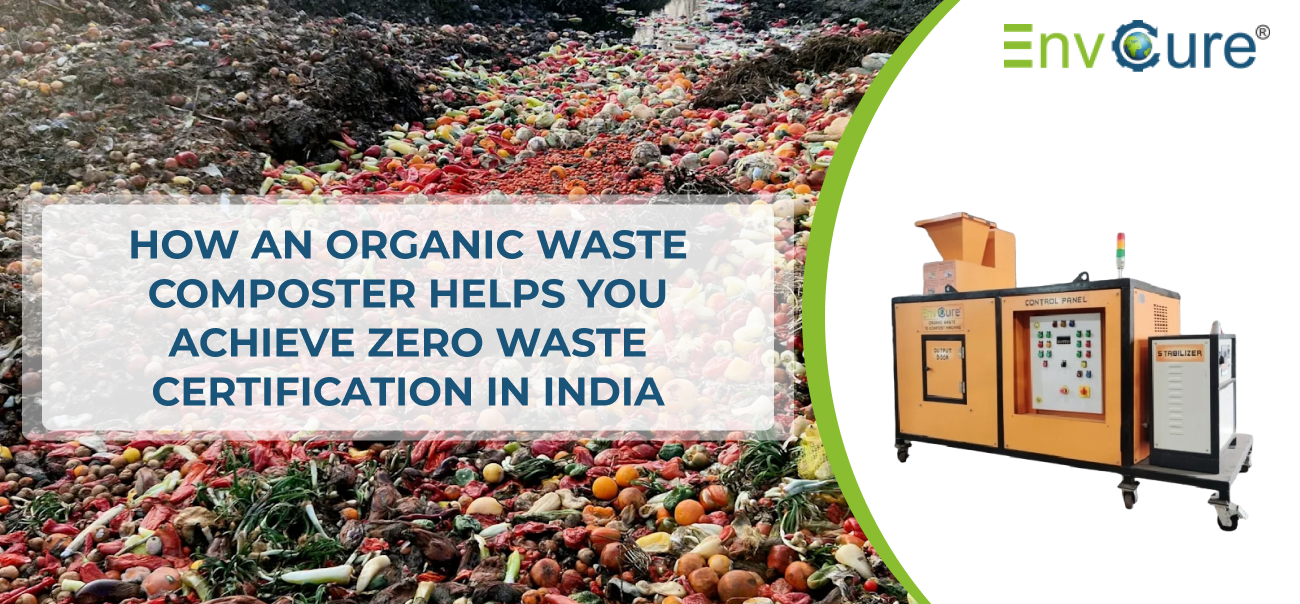

An organic waste composter is quickly becoming the single most important piece of equipment for Indian businesses chasing a zero waste certification. If your building generates food waste, canteen leftovers, or garden trimmings, this one machine can be the difference between a stalled application and a certified, landfill-free facility.
In this article, we will walk through exactly why that is, and how the right composting technology gets you there faster than any manual process ever could.
Understanding Zero Waste Certification Requirements in India
Zero waste certification is not a single, fixed label handed out by one authority. It is a set of standards that different green building bodies use to measure how much of a facility’s total waste is diverted away from landfills and incinerators.
For most Indian businesses, especially those in manufacturing, hospitality, and commercial real estate, this certification has become a genuine business advantage, not just a sustainability checkbox.
As we’ll see through this article, an organic waste composter is usually the single piece of equipment that closes the largest gap in a facility’s diversion numbers.
What is Net Zero Waste Certification? (GRIHA vs. IGBC Frameworks)
In India, the two most recognised frameworks come from GRIHA (Green Rating for Integrated Habitat Assessment) and IGBC (Indian Green Building Council). Both of these frameworks assess how a facility manages its solid waste on-site, but their criteria differ slightly.
GRIHA tends to focus heavily on resource efficiency across a building’s full lifecycle, while IGBC’s zero waste rating leans more on measurable diversion rates and documented waste segregation practices.
Regardless of which framework your project follows, one requirement is common to both: you need verifiable proof that organic waste is being treated on-site rather than trucked away.
Struggling with food waste disposal? Learn about the biggest food waste management challenges and how an organic waste composter solves them efficiently.
Meeting the 75% to 90%+ Landfill Diversion Thresholds
Most certification tiers require that somewhere between 75% and over 90% of total waste generated should not go to the landfills. That is a steep target, and it is nearly impossible to hit without addressing organic or “wet” waste directly, since food and garden waste typically makes up 50-60% of total waste volume in Indian commercial and institutional settings.
An organic waste composter tackles this exact chunk of the waste stream, which is why auditors and certification consultants almost always ask about on-site composting capacity first.
Why Wet Waste is the Biggest Hurdle to Your Certification
Dry waste like paper, plastic, and metal is relatively easy to segregate and send for recycling. Wet waste is trickier. It decomposes fast, smells within hours, attracts pests, and cannot simply sit in a bin waiting for a recycler to collect it.
Many facilities fail their first certification attempt not because they lack recycling partners, but because they have no reliable system for daily wet waste processing. This is precisely the gap an organic waste composter is designed to close.
How an Organic Waste Composter Accelerates Your Certification Journey
Once a facility installs the right machine, its landfill diversion numbers change almost immediately, and the paperwork required for certification becomes far easier to compile.
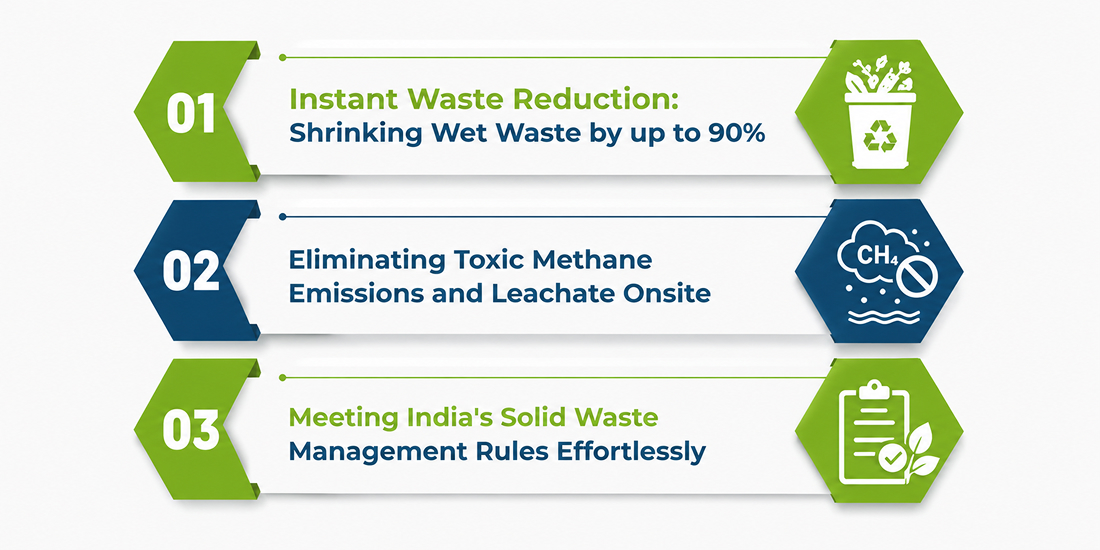
Instant Waste Reduction: Shrinking Wet Waste by up to 90%
A well-designed organic waste composting machine can shrink the weight of raw food waste by up to 90% as it processes it, since most of that weight is simply water that evaporates during decomposition.
That means, with the help of an organic waste composter, a canteen generating 100 kg of food waste a day is left with around 10 kg of finished, stable compost, all of it processed on-site with nothing sent to a landfill. This dramatically cuts down what needs to be transported, weighed, and reported.
Eliminating Toxic Methane Emissions and Leachate Onsite
When left in an open landfill, organic waste doesn’t just sit there quietly. It decomposes without oxygen and gives off methane, a gas that’s roughly 28 times more potent than carbon dioxide at trapping heat over a 100-year period. On top of that, rotting waste produces leachate, a toxic liquid that seeps into the ground and can quietly poison soil and groundwater.
A properly enclosed waste composting machine processes organics aerobically, meaning oxygen is present throughout, which prevents methane formation and controls leachate at the source. This is one of the strongest environmental arguments certification bodies look for in an applicant’s report, and it is exactly the outcome a well-maintained food waste composting machine is designed to deliver, cycle after cycle.
Meeting India’s Solid Waste Management Rules Effortlessly
The Solid Waste Management Rules, 2016, classify any establishment generating over 100 kg of waste a day, including many hotels, hospitals, and large housing societies, as a ‘bulk waste generator,’ and require these generators to process their biodegradable waste on-site as much as possible.
An organic waste composter helps a facility comply with this requirement automatically, since it is designed specifically to handle daily biodegradable loads without external intervention.
Facilities that already run a compliant waste composter machine typically find the certification documentation process much smoother, because compliance and certification requirements overlap heavily here.
In our experience, sites operating an organic waste composting machine rarely face major gaps during inspections, since daily biodegradable processing is already built into their routine.
From cutting waste collection costs to producing valuable compost, learn why an organic waste composter offers excellent ROI for hospitality businesses.
Step-by-Step: Integrating an Organic Waste Composter into Your Workflow
Adopting composting technology is not just about buying a machine. It is about building a workflow around it.
Waste Sorting at Source: Separating Organics from Inorganics
Every successful composting program starts with clean segregation. Staff need clearly labelled bins for wet and dry waste, along with basic training on what counts as compostable.
Contamination from plastic wrappers or metal cutlery is the single biggest cause of reduced compost quality, so this first step matters more than most facilities initially expect.
Once sorted, the organics are ready to feed directly into an organic waste composter for processing.
The 24-Hour Process: How Microbes Digest Food Scraps
Inside a modern food waste composting machine, the real work is done by naturally occurring microbes, which break down organic material with the help of controlled temperature, moisture, and aeration. Most commercial units complete this entire process in just 24 hours, turning raw food scraps into a stable, odour-free compost that’s safe to handle right away.
This is a significant leap from traditional pit composting, which can take several weeks and requires far more manual turning and monitoring.
Utilizing or Selling the Nutrient-Rich Organic Compost Output
The compost produced is not simply a waste byproduct to dispose of. It is a nutrient-rich soil amendment that many facilities use in their own landscaping, or sell to local farmers and nurseries.
Some larger industrial campuses have even turned their composting output into a small secondary revenue stream, offsetting part of the machine’s operating cost over time. This is one of the underappreciated benefits of running an organic waste composter on-site, rather than sending wet waste away for someone else to process.
Commercial kitchens generate large volumes of food waste every day; learn how an organic waste composter turns this challenge into measurable cost savings and a strong return on investment.
Achieving Sustainability Milestones with EnvCure Technocrat LLP Solutions
EnvCure Technocrat LLP is a Gujarat-based manufacturer of waste management equipment built for Indian industrial and commercial conditions. Our range includes organic composting machines, shredders, and incinerators, all engineered to help businesses meet local waste management rules while working toward larger sustainability goals like zero waste certification.
Why Industries Trust EnvCure Technocrat LLP for Automatic Composting Systems
Industries across Gujarat and beyond choose our organic waste compost machine because it is built for consistent, low-maintenance daily operation rather than occasional or seasonal use.
We design our equipment around real Indian operating conditions, including variable power supply, humidity, and high daily throughput, so the machines keep performing long after installation. This reliability is exactly what makes an organic waste composter from EnvCure Technocrat LLP a long-term investment rather than a short-term fix.
Scalable Solutions: From Commercial Kitchens to Industrial Hubs
Whether a client needs a compact organic waste composter for a single commercial kitchen or a high-capacity system for a large industrial hub, EnvCure Technocrat LLP offers models sized to match actual daily waste volumes.
This scalability means a facility does not have to overpay for capacity it will never use, or underinvest in a machine that cannot keep up with growth. Every organic waste compost machine we manufacture is tested for continuous industrial duty cycles before it ever reaches a client site.
Beyond the Machine: Maintenance and Compliance Support by EnvCure
Buying the machine is only the first step. EnvCure Technocrat LLP also supports clients with installation guidance, routine maintenance, and documentation that can be used directly in certification and regulatory filings.
This ongoing support is often what separates a facility that struggles to sustain its certification from one that maintains it year after year. Every organic composting machine we deliver comes with a maintenance schedule tailored to its actual usage pattern, not a generic one-size-fits-all plan.
Conclusion
Zero waste certification in India increasingly depends on how well a facility handles its organic waste, and an organic waste composter is the most direct way to close that gap. From cutting wet waste volume by up to 90%, to eliminating methane and leachate, to meeting the Solid Waste Management Rules without added effort, the case for on-site composting is hard to ignore.
If your business is preparing for certification, or simply wants a more sustainable way to manage daily waste, EnvCure Technocrat LLP‘s composting systems are built to support that journey from day one. A reliable waste composter machine is not just an equipment purchase; it is the foundation your entire certification strategy can be built on.
FAQs Related to Organic Waste Composter
1. How does an organic waste composter help achieve Zero Waste Certification in India?
A: An organic waste composter processes biodegradable waste at the source, significantly reducing the amount of waste sent to landfills. By improving waste diversion rates and supporting proper wet waste management, it helps organizations meet key requirements for Zero Waste Certification in India.
2. Who should install an organic waste composter?
A: Organic waste composters are ideal for:
- Hotels and resorts
- Hospitals
- Educational institutions
- Corporate offices
- Housing societies
- Restaurants
- Food processing units
- Industrial campuses
Any organization generating a significant amount of food or garden waste can benefit from on-site composting.
3. What types of waste can be processed in an organic waste composting machine?
A: Most organic waste composting machines can process:
- Food leftovers
- Fruit and vegetable peels
- Garden waste
- Tea and coffee waste
- Flower waste
- Canteen waste
Non-biodegradable materials such as plastic, glass, and metal should not be added.
4. How much can an organic waste composter reduce waste volume?
A: Most commercial organic waste composters can reduce the volume and weight of biodegradable waste by up to 80–90%, depending on the waste composition and machine technology.