




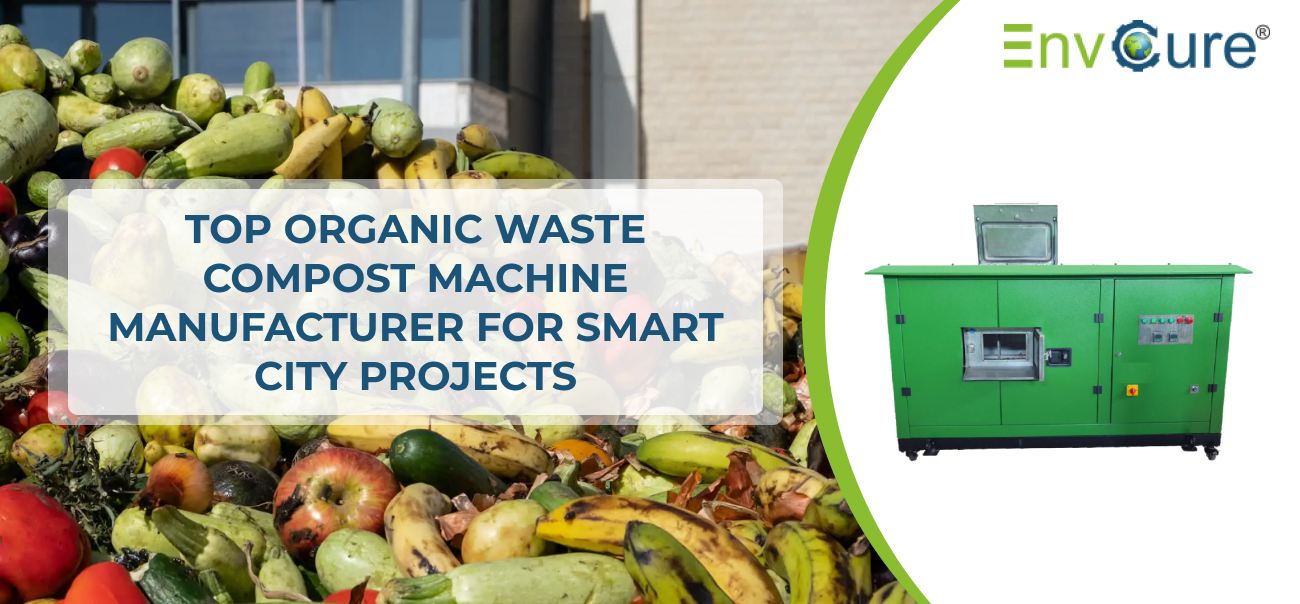

If you are researching an organic waste compost machine for a smart city project, a housing society, or an industrial campus, you have probably noticed that not every machine on the market is built for daily, high-volume use. Indian cities generate more wet waste every year, and simply dumping it at the edge of town is no longer acceptable to municipal corporations or pollution control boards.
A reliable organic waste compost machine turns this daily waste problem into something useful: nutrient-rich compost that goes straight back into parks, farms, and green belts.
This article covers how the process works, what to check before buying, and why EnvCure Technocrat LLP has become a trusted manufacturer in this space.
EnvCure Technocrat LLP: Leading Organic Waste Compost Machine Manufacturer
EnvCure Technocrat LLP is a Gujarat-based organic waste compost machine manufacturer with more than seven years of experience designing waste management equipment. Our facility is located in Vatva GIDC, Ahmedabad.
From there, we have shipped over 2,500 machines to clients in more than five countries, including Ahmedabad Municipal Corporation, several nagarpalikas across Gujarat, and institutions such as IIT Gandhinagar and IIM Ahmedabad.
As a manufacturer of organic composting machine technology for both compact campuses and multi-ton municipal sites, we build every machine to run daily without breaking down.
Beyond landfill reduction, composting contributes to formal green goals; see how an organic waste composter helps achieve zero-waste certification.
Mission and Engineering Excellence at EnvCure Technocrat LLP
Our mission is simple: give cities and industries a practical way to manage wet waste without depending on landfills. Every organic waste compost machine we manufacture goes through in-house engineering review, from motor sizing to shredding blade design, so it holds up under real municipal conditions.
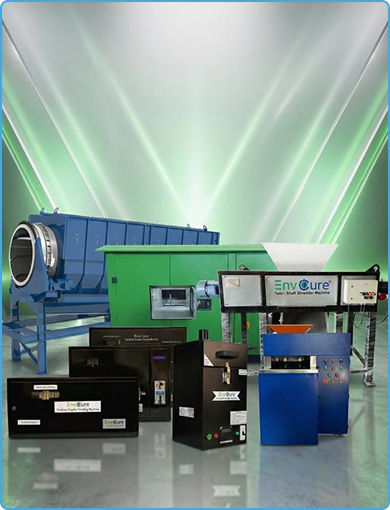
We also manufacture semi-automatic and fully automatic waste composting machine models, plus a compact food waste composting machine for kitchens and smaller campuses.
Key Features of an EnvCure Technocrat LLP Organic Waste Compost Machine
Every unit we build shares a few core features:
- Integrated shredder that reduces waste particle size before composting
- Automatic moisture and aeration control for faster decomposition
- Odor-control systems suited for closed, urban installations
- Capacity options from small housing societies to multi-ton municipal plants
- Lower power consumption compared to open windrow composting
These features separate a genuine organic waste composting machine from a basic drum that just holds waste without actively processing it.
How EnvCure Technocrat LLP Empowers Smart City Initiatives
Smart city missions need decentralized waste solutions, where waste is treated close to where it is generated instead of trucked to a central landfill. An organic waste compost machine fits directly into this model.
Municipal corporations, resident welfare associations, and campuses can install a unit on-site, process wet waste daily, and use the compost locally, cutting transport costs and truck emissions.
Case Studies & Government Alignment
We have supplied organic waste compost machines to real projects, not just pilots. Vadnagar Nagarpalika runs our EC-OWC-500 for town-level processing, and Nirma University uses our EC-OWC-250 on campus. We have also worked with Ahmedabad Municipal Corporation and nagarpalikas in Navsari, Valsad, and Vapi.
Every machine we build aligns with India’s Solid Waste Management Rules, 2016, which require urban local bodies to process wet waste near the source, helping municipalities meet this obligation directly.
Managing wet waste comes with real challenges; see the top problems in food waste management and how an organic waste composter solves them.
Step-by-Step Process of an Organic Waste Compost Machine
Wondering how an organic waste composter actually turns kitchen and market waste into usable compost? Here is the process in four steps.
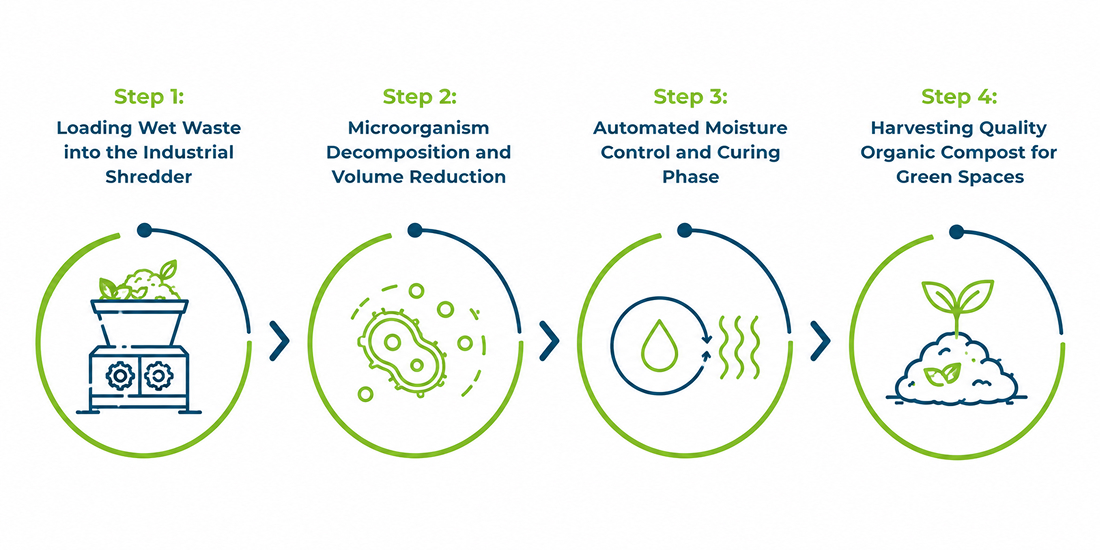
Step 1: Loading Wet Waste into the Industrial Shredder
The process begins when wet waste, food scraps, garden trimmings, or market waste is loaded into the machine’s shredder, which cuts material into smaller, uniform pieces to speed up decomposition later.
Step 2: Microorganism Decomposition and Volume Reduction
Once shredded, the waste moves into the composting chamber, where naturally occurring microorganisms break it down. Volume drops sharply, often by 70 to 90 percent, as organic matter turns into a stable, soil-like material.
Step 3: Automated Moisture Control and Curing Phase
A well-built waste composter machine keeps moisture within a set range automatically, since compost that is too wet or too dry decomposes poorly. Afterward, the material enters a curing phase, where it stabilizes, and any remaining odor fades. This is where a dependable waste composter machine really shows its value.
Step 4: Harvesting Quality Organic Compost for Green Spaces
The final output is dark, crumbly, nutrient-rich compost that can be sieved and bagged for municipal parks, farms, or gardens, closing the loop between daily waste generation and a genuinely useful output.
Benefits of Installing an Organic Waste Compost Machine
Reducing Municipal Landfill Volume by Up to 90%
Because an organic waste composting machine breaks down organic material on-site, far less waste ends up trucked to landfills, cutting landfill volume from the wet waste stream by as much as 90 percent.
Lowering Carbon Footprint and Methane Gas Emissions
When organic waste rots in an open landfill without oxygen, it releases methane, a greenhouse gas far more potent than carbon dioxide. Composting the same waste aerobically through an organic waste composter avoids most of these emissions.
Producing Nutrient-Rich Compost for Municipal Parks
Whether the source is a kitchen, canteen, or market yard, a good food waste composting machine turns that waste into compost rich in organic matter and micronutrients, useful for parks, roadside plantations, and urban farms, reducing the need for chemical fertilizer.
Smart City Guide to Selecting an Organic Waste Compost Machine
Choosing Daily Capacity from 100 kg to Multi-Ton Units
Capacity is the first thing to decide. A small organic composting machine for a housing society might process around 100 kg per day, while a municipal-grade unit can handle 2,000 kg per day or more.
Pick a machine size that matches how much waste you generate each day, and leave some room for future growth.
Assessing Energy Efficiency and Odor Control Systems
Since these machines run daily, power consumption adds up fast. Compare energy use per ton processed, and confirm the odor-control system is rated for enclosed, urban placement.
Verifying Compliance, Warranty, and Technical Support
Before buying, check that the manufacturer offers a valid warranty, spare-parts availability, and after-sales service, since a waste composting machine without local support can sit idle during a breakdown. Also confirm the equipment meets Solid Waste Management Rules and pollution control requirements for your state.
Conclusion: Build Sustainable Smart Cities with EnvCure Technocrat LLP
Choosing the right organic waste compost machine is not just a procurement decision; it is a step toward cleaner cities and reduced reliance on landfills.
With more than seven years of manufacturing experience, over 2,500 machines installed, and clients ranging from municipal corporations to leading universities, we at EnvCure Technocrat LLP build equipment for real, daily use, not demonstration purposes.
Whether you need a compact unit for a single campus or a multi-ton system for city-wide deployment, our team can help you plan the right machine.
FAQs Related to Organic Waste Compost Machine
Q: What is an organic waste compost machine and how does it work?
A: An organic waste compost machine converts food and organic waste into compost through shredding, microbial decomposition, and controlled moisture and curing. It reduces waste volume by up to 90% and produces nutrient-rich compost, usually within 24 hours to a few weeks.
Q: What capacity of organic waste compost machine do I need?
A: Organic waste compost machines range from 100 kg per day to multi-ton units. Housing societies and small canteens suit smaller models, while municipalities, Smart Cities, and large institutions need high-capacity machines matched to their daily wet waste volume.
Q: How do organic waste compost machines help Smart City projects?
A: In Smart City projects, organic waste compost machines process wet waste on-site, reducing landfill volume by up to 90%, lowering methane emissions, and producing compost for municipal parks and green spaces. They support waste segregation and sustainability goals.
Q: What comes out of an organic waste compost machine?
A: The output is dry, odourless, nutrient-rich compost, also called organic manure. It can be used for gardens, farms, landscaping, and municipal parks. It is a natural, chemical-free alternative to synthetic fertilisers, produced from everyday food and organic waste.