



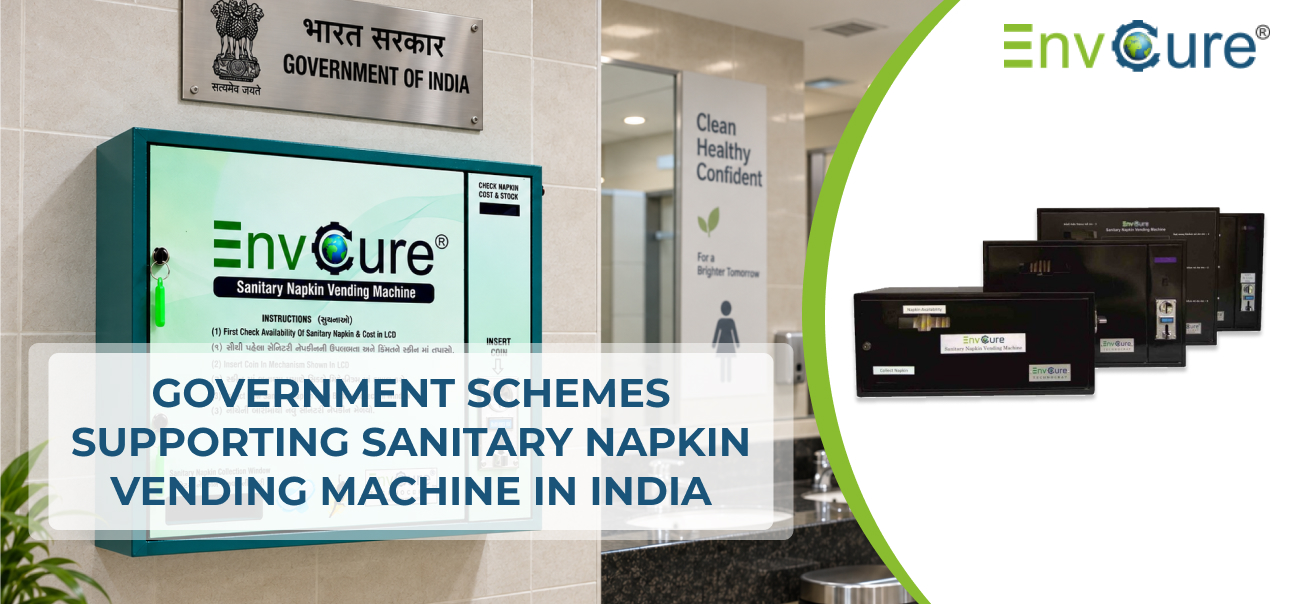

Access to menstrual hygiene products is now a policy priority in India, not just a health issue. A sanitary napkin vending machine placed in a school, college, hospital, or public toilet solves a problem millions of women and girls face daily: not having a pad on hand when they need one.
Over the last decade, the central government and several states have built schemes and grants that make it easier for institutions to install a sanitary napkin vending machine, often with subsidised or fully funded equipment.
This guide walks you through the schemes, the eligibility rules, and what to look for before you select a sanitary napkin vending machine.
Central Government Schemes Supporting Sanitary Napkin Vending Machine Setup
Central ministries have folded menstrual hygiene infrastructure into larger programmes rather than running one standalone scheme, which is why funding can look scattered.
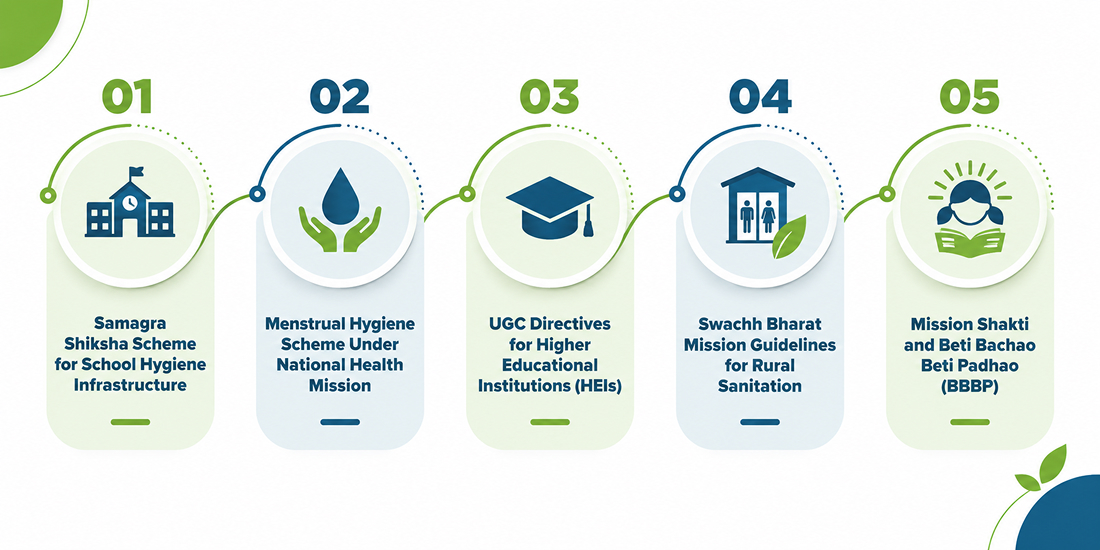
Samagra Shiksha Scheme for School Hygiene Infrastructure
Under Samagra Shiksha, the Ministry of Education funds school infrastructure, and a sanitary pad vending machine in schools is treated as part of that grant, alongside an incinerator for safe disposal.
Menstrual Hygiene Scheme Under National Health Mission
The National Health Mission’s Menstrual Hygiene Scheme supplies low-cost pads through ASHA workers and supports vending machine installation at community health centres in rural areas.
UGC Directives for Higher Educational Institutions (HEIs)
The University Grants Commission hasn’t left this to individual colleges to decide on their own. Its gender-inclusive infrastructure norms specifically call for a sanitary napkin vending machine on every campus, and it has to come with an incinerator, not just the dispenser alone.
Swachh Bharat Mission Guidelines for Rural Sanitation
Swachh Bharat Mission (Grameen) doesn’t treat menstrual hygiene as a side issue either. Its guidelines push local governments to fit vending units into community toilet complexes, folding this in as part of what rural sanitation is supposed to cover in the first place.
Mission Shakti and Beti Bachao Beti Padhao (BBBP)
Mission Shakti now carries the BBBP mandate forward, and part of its district-level funding regularly goes toward exactly this kind of infrastructure. In practice, that’s how a napkin dispenser machine ends up installed in a government school or an Anganwadi centre.
Schools can promote better menstrual hygiene by installing a reliable sanitary napkin vending machine for schools in India, providing students with convenient and discreet access to sanitary products.
State Government Initiatives Driving Pad Vending Machine Adoption
States have layered their own programmes on top of central schemes, often with faster disbursal.
Kerala She-Pad Scheme
Kerala’s She Pad initiative places a sanitary napkin vending machine and incinerator in every government school, co-funded by local bodies.
Bihar MHM Programme
Bihar’s Menstrual Hygiene Management programme funds vending machines in girls’ schools and hostels across districts.
Delhi School Menstrual Hygiene Scheme
Delhi government schools have rolled out free sanitary vending machine under a dedicated hygiene drive, with maintenance built into the annual school grant.
Rajasthan Swasthya Chetna Public Hotspot Drive
Rajasthan’s programme extends vending infrastructure to bus stands and public hotspots for wider access.
West Bengal “Bandhan” Public Toilet Infrastructure
West Bengal’s Bandhan initiative fits vending units into public toilet complexes built under municipal sanitation budgets.
Learn more about sanitary vending machine requirements in India and what Supreme Court observations and government guidelines say about menstrual hygiene facilities.
Grant Eligibility and Procurement Process for Public Institutions
Eligible Applicants
Government and government-aided schools, colleges, hostels, health centres, and Anganwadi centres are typically eligible. Private institutions can apply through CSR tie-ups instead of direct grants.
Step-by-Step Procurement via State PIPs
Institutions apply through their district education or health office as part of the state’s annual Programme Implementation Plan, get budget approval, then procure from an empanelled vendor.
Mandatory Technical Standards
Machines must meet basic electrical safety norms, and paired incinerators need to be CPCB-compliant for biomedical waste disposal.
Combining CSR Funds with Schemes
Institutions often top up government grants with CSR funds, which speeds up installation of a sanitary pad vending machine in schools that would otherwise wait years for budget approval. In our experience, CSR-backed proposals for a sanitary pad vending machine in schools clear internal committee approvals faster when the incinerator and maintenance plan are bundled into the same proposal.
Technical Criteria for Selecting a Sanitary Napkin Vending Machine
Manual Versus Automatic Power Configuration
Manual coin-drop units are cheaper and need no electricity; automatic machines dispense faster and suit high-traffic locations but need stable power.
Coin, Token, and Cashless UPI/RFID Payment
Newer machines increasingly support UPI and RFID payments alongside coins, which matters on urban campuses where students rarely carry change.
Build Quality for High-Footfall Areas
For hostels and railway stations, look for a sanitary napkin vending machine with a steel or powder-coated body, higher pad capacity, and tamper-resistant locks. A well-built sanitary pads vending machine in these locations usually needs far less field servicing over its first two years.
Get Smart Vending Machine Solutions with EnvCure Technocrat LLP
We are EnvCure Technocrat LLP, a Gujarat-based manufacturer working in waste management and hygiene equipment, and we design and supply a sanitary napkin vending machine built to be used in institutions, government buildings, schools, and other places.
Why EnvCure Technocrat LLP is a Trusted Infrastructure Partner
Our team understands the requirements that come with government tenders and CSR-backed projects, so our machines are built to meet the technical standards institutions must follow, without complications during approval.
Key Features of EnvCure Vending Machine Models
IoT Inventory Tracking and Auto-Replenishment
Our smart models use IoT sensors to track pad stock in real time and alert staff before a machine runs empty, so a napkin dispenser machine on a busy campus never sits unused.
Heavy-Duty Vandal-Proof Bodies for Public Spaces
We build our units with reinforced, vandal-resistant enclosures that are best suited for public toilets, bus stands, and railway platforms that see continuous heavy and unsupervised use.
High-Capacity Dispensing for Peak Usage
Our high-capacity models are designed for schools and hostels with large footfall. In this way, our machines keep downtime low even during peak hours.
Turnkey Installation, CPCB-Compliant Incinerators, and Maintenance
We offer turnkey support, from site assessment to installation, CPCB-compliant incinerators for safe disposal, and ongoing maintenance, making it easier for institutions to stay compliant after rollout.
Before investing in a vending solution, learn how to choose the right sanitary napkin vending machine for schools, offices, hospitals, and other institutions.
Conclusion
Installing a sanitary napkin vending machine in a school, college, or public facility in India is more achievable today than a few years ago, thanks to overlapping central and state schemes, CSR partnerships, and capable domestic manufacturers.
Whether you apply through Samagra Shiksha, a state MHM programme, or combine a grant with CSR funds, the goal stays the same: making sure a pad is within reach when someone needs one.
If your institution is evaluating vendors, we at EnvCure Technocrat LLP would be glad to walk you through options suited to your location and footfall.
FAQs Related to Sanitary Napkin Vending Machine
Q1. Are there government schemes for sanitary napkin vending machines in India?
Yes. Various government programmes and initiatives support menstrual hygiene in schools and public institutions, including access to sanitary napkins, vending machines, and disposal facilities.
Q2. Which government schemes support menstrual hygiene management in India?
Major initiatives include the Menstrual Hygiene Scheme under NHM, Samagra Shiksha, and other state-level menstrual hygiene programmes supporting access, awareness, and sanitation facilities.
Q3. Can schools get financial support for sanitary napkin vending machines?
In some cases, schools may receive support through government schemes, state programmes, or approved institutional budgets. Eligibility and funding depend on the applicable programme and state.
Q4. How can a school apply for government support?
Schools generally need to approach the relevant education department, government implementing agency, or state programme to check eligibility, funding availability, and procurement procedures.
Q5. Can CSR funds be used for sanitary napkin vending machines?
Yes, CSR funding can potentially support menstrual hygiene and sanitation projects, subject to applicable CSR rules and the eligibility of the implementing organisation.